You married the man you loved. He was caring, attentive, and fully present. Then, slowly — or maybe all at once — something shifted. He became distant. Irritable. Indifferent. You wonder what changed. You wonder if you did something wrong. You wonder if this is just how marriage goes, or if something deeper is happening.
I have sat across from thousands of women in my 15 years of practice who have described exactly this feeling. And in most cases, the answer is not what they expected. It is not just stress at work. It is not another woman. It is not a personality flaw. In Vedic astrology, a husband's emotional withdrawal after marriage has clear planetary signatures. Once you understand what is happening in the chart, the confusion starts to lift.
In this article, I will explain the main astrological reasons why a husband changes after marriage, which Dashas and planetary transits cause emotional distance, and what remedies genuinely help.
If you want a personal reading of your Kundali and your husband's chart right now, contact me on WhatsApp, and I will analyze your specific situation.
Why Does a Husband Change After Marriage? The Vedic Explanation
In Vedic astrology, marriage does not exist in isolation. The moment two people marry, a new set of planetary influences activates. The 7th house of both charts begins to operate differently. The Dasha periods of both individuals start to interact. What felt natural during the courtship period — governed by the 5th house of romance — now gives way to the 7th-house reality of a committed partnership.
The 5th house is about attraction, excitement, and the thrill of new love. The 7th house is about long-term commitment, negotiation, and the responsibilities of partnership. Many men who were expressive and loving during the dating phase withdraw after marriage because the planetary energies governing pre-marriage romance (5th house) are no longer as active.
This is not a personal failure. It is a cosmic shift. But it does not mean you have to accept it silently.
Planetary Positions That Cause a Husband to Change After Marriage
1. Saturn's Influence on the 7th House
Saturn in the 7th house, or Saturn transiting the 7th house after marriage, is the single most common planetary reason for a husband becoming cold and emotionally unavailable.
Saturn creates distance. It brings a sense of duty without warmth. A man under heavy Saturn influence on his 7th house will feel the weight of responsibility but will struggle to express love or tenderness. He may not even understand why he feels this way. He becomes serious, withdrawn, and sometimes critical.
Saturn transits last 2.5 years. If your husband changed dramatically within a year or two of marriage, check whether Saturn has moved into his 7th house or is aspecting his Venus.
2. Rahu in the 7th House
Rahu in the 7th house creates what I call obsessive incompleteness in marriage. The native desires an intense relationship before marriage. Once the relationship is secured, Rahu moves its focus elsewhere — career, ambition, status, sometimes an unhealthy fascination with something outside the home.
If your husband had Rahu in his 7th house, he may have been highly focused on winning your love before marriage. After the wedding, that same energy may have shifted toward his professional world, leaving the marriage feeling empty to you.
To understand the deeper impact of Rahu on relationships, read my detailed article on Vashikaran Specialist — Understanding Planetary Influences on Love.
3. Ketu Transiting the 7th House
Ketu brings detachment. When Ketu transits the 7th house — which happens every 18 months as part of the Rahu-Ketu axis shift — the husband may suddenly feel philosophically distant from the marriage. He does not necessarily want to leave. He just feels spiritually unmoored and pulled inward.
This transit creates a period where he seems to look right through you. He is physically present but emotionally absent. This is usually temporary, lasting about 18 months, but without understanding what is happening, couples can do significant damage to the relationship during this time.
4. Mars Affliction and Anger After Marriage
Some husbands do not become cold — they become hot. Irritable, easily angered, critical, and combative. This is typically a Mars affliction.
When Mars is positioned in the 1st, 4th, 7th, 8th, or 12th house — what we call Manglik placement — it can create friction within marriage. The energy that felt passionate during courtship becomes volatile after the wedding. Arguments start over small things. The husband becomes defensive and reactive.
This is related to the broader question of Manglik Dosh and its effects on married life. A proper kundali analysis will show whether Mars is the root cause and what specific remedies apply.
5. Venus Dasha Ending, Saturn Dasha Beginning
This is one of the most overlooked reasons, and one of the most powerful.
Venus Dasha is a 20-year period governed by the planet of love, beauty, pleasure, and romance. Men in Venus Dasha are naturally more romantic, expressive, and relationship-oriented. When this period ends, and Saturn Dasha begins — a 19-year period — everything shifts.
Saturn governs discipline, duty, austerity, and hard work. A man who was in Venus Dasha when you were dating and first married may have entered Saturn Dasha after the wedding. He did not change. His Dasha did.
Timing the Dasha period is the single most important piece of Dasha-Antardasha analysis I do in every marriage consultation. It tells us exactly when things changed and what to expect next.
Want to know which Dasha your husband is currently running and what it means for your marriage? Message me on WhatsApp for a personal Kundali reading.
What the Navamsa (D9) Chart Reveals
The Navamsa chart — the D9 divisional chart — is the most important chart for understanding the true nature of a marriage and a spouse. In my practice, I always read the D9 chart alongside the main birth chart (D1) when counseling women who say their husband has changed.
The D9 chart reveals the spouse's true character that emerges after marriage. It is not always visible during courtship. The D1 chart shows who you attract. The D9 shows what that person becomes once the marriage is established.
If a man's D9 chart shows Saturn in a prominent position, or a weak Venus in the 7th of the D9, his post-marriage behavior is always written in his chart. The cold, withdrawn, or critical behavior after marriage is not random — it is the D9 expressing itself.
Understanding the Navamsa chart is deeply technical. Book a consultation, and I will walk you through both your charts together, comparing the D1 and D9 to explain exactly what is happening.
Common Situations and Their Astrological Causes
He Became Distant and stopped talking
Silent withdrawal after marriage is almost always either Saturn or Ketu at work. Saturn creates emotional withholding. Ketu creates philosophical detachment. Both result in a husband who is present but unreachable.
Remedies for Saturn: Shani Puja on Saturdays, chanting the Shani Beej Mantra 108 times, wearing a blue sapphire or amethyst (only after gemstone analysis), donating sesame seeds and black cloth on Saturday.
Remedies for Ketu: Ganesh Puja, Ketu mantra chanting, and specific fasting practices I prescribe based on the individual chart.
He Became Angry and Critical
Mars affliction is the cause here in most cases. Pati Patni mein kalesh — constant arguments and criticism — is a Mars problem.
For remedies related to husband-wife conflict, read my detailed guide on Pati Patni Mein Kalesh Ke Upay. It covers both Vedic mantras and practical remedies for reducing daily conflict.
He Lost Interest in the Marriage
Loss of interest — not anger, not distance, just plain indifference — is a Rahu problem when combined with a weakened 7th lord.
This is the hardest situation for women because there is nothing concrete to point to. He is not mean. He is not absent. He simply does not seem to care. This requires a full Venus and 7th lord analysis in both the D1 and D9 charts.
He Became Attracted to Someone Else
I will be direct about this because many women who consult me are asking this question beneath the surface. Rahu conjunct or aspecting Venus in the 7th house, combined with a weak 7th lord, is the combination most associated with a spouse whose attention strays outside the marriage.
This does not mean it is destined or permanent. Dashas change. Transits shift. And strong remedies — particularly Mohini Vashikaran practices and specific puja rituals — can significantly strengthen the bond between husband and wife.
Read my article on Mohini Vashikaran — How It Works and What It Can Do for a deeper understanding of how this works.
Vedic Remedies When Your Husband Has Changed After Marriage
Remedies in Vedic astrology work differently from what most people expect. They do not force a person to behave differently. They shift the planetary energies that are creating the behavioral pattern. When the planetary pressure is reduced, the relationship's natural state can restore itself.
Remedy 1 — Strengthen Venus in Your Own Chart
Venus governs love, attraction, and marital harmony in both male and female charts. Strengthen your own Venus, and you create a magnetic pull that naturally draws your husband back toward the relationship.
Remedy 2 — Reduce Saturn's Grip on the Marriage
Remedy 3 — Perform Grah Shanti Puja for the 7th House Lord
The 7th house lord governs the quality of your marriage partner. If it is afflicted, a Grah Shanti Puja specific to that planet can create visible shifts in your husband's behavior within weeks. This is not a generic remedy — it must be performed based on your exact chart.
Remedy 4 — Strengthen Marital Energy with Sumangali Puja
Sumangali Puja is performed by married women to strengthen and prolong the marriage bond. It involves specific mantras, offerings of turmeric, sindoor, and red flowers, and is ideally performed on a Monday or Friday during the waxing moon phase.
Remedy 5 — Consult Before Attempting Vashikaran
Many women come to me after trying generic vashikaran mantras they found online. Sometimes these work partially. More often, they create additional complications because the mantra was not matched to the specific planetary situation.
If you are considering vashikaran as a path, read my guide on Vashikaran — What It Is and How It Works first. Then consult me directly so I can identify the correct approach for your specific chart.
I have guided over 50,000 individuals through exactly these situations. If your husband has changed after marriage and you want real answers based on your Kundali, message me on WhatsApp right now. I will personally read your chart and tell you what is happening and what to do.
When Should You Seek Astrological Help?
Most women wait too long. They try to adjust. They hope things will return to normal. They blame themselves. By the time they reach me, months or years have passed, and the distance has grown significantly.
Seek a Kundali consultation as soon as you notice a change — not after the situation becomes a crisis. The earlier we identify the planetary cause, the faster the remedies work and the more complete the recovery.
You should consult now if:
Your husband became emotionally unavailable within the first three years of marriage.
Daily arguments have become the norm in your home.
Your husband shows no interest in physical or emotional intimacy.
You suspect his attention has moved outside the marriage.
You feel alone inside your marriage.
Related Services and Articles
These resources are directly relevant to the situation described in this article:
Husband-Wife Dispute — Grah Kalesh Specialist
Frequently Asked Questions
Can astrology really explain why my husband changed after marriage?
Yes. Vedic astrology maps the exact Dasha period, transit influences, and natal chart placements that govern a person's behavior during different life phases. When a husband changes significantly after marriage, there is almost always a clear planetary cause visible in the chart.
How long does it take for remedies to show results?
Most people notice a shift within 40 to 90 days of consistent remedy practice. For deeper afflictions — particularly Saturn Dasha — changes may take 6 months to become clearly visible. Consistency is the most important factor.
Is this a permanent change in my husband, or is it temporary?
In my experience, most cases of post-marriage emotional withdrawal are Dasha-driven and therefore temporary. When the Dasha shifts, the behavior shifts with it. The question is whether the marriage can sustain the difficult period. Remedies help protect the relationship during that time.
Do both our charts need to be analyzed?
Ideally, yes. Comparing both charts — and particularly both Navamsa D9 charts — gives the clearest picture. I can work with just one chart if the other person's birth details are unavailable, but the reading will be more complete with both.
Can Vashikaran help bring back my husband's love?
Vashikaran, when performed correctly based on the specific chart, can strengthen the emotional bond and draw a partner's attention back to the marriage. It is not a shortcut or a trick — it works through the same planetary energies as all Vedic remedies. Read my full guide on Vashikaran to understand the process properly.
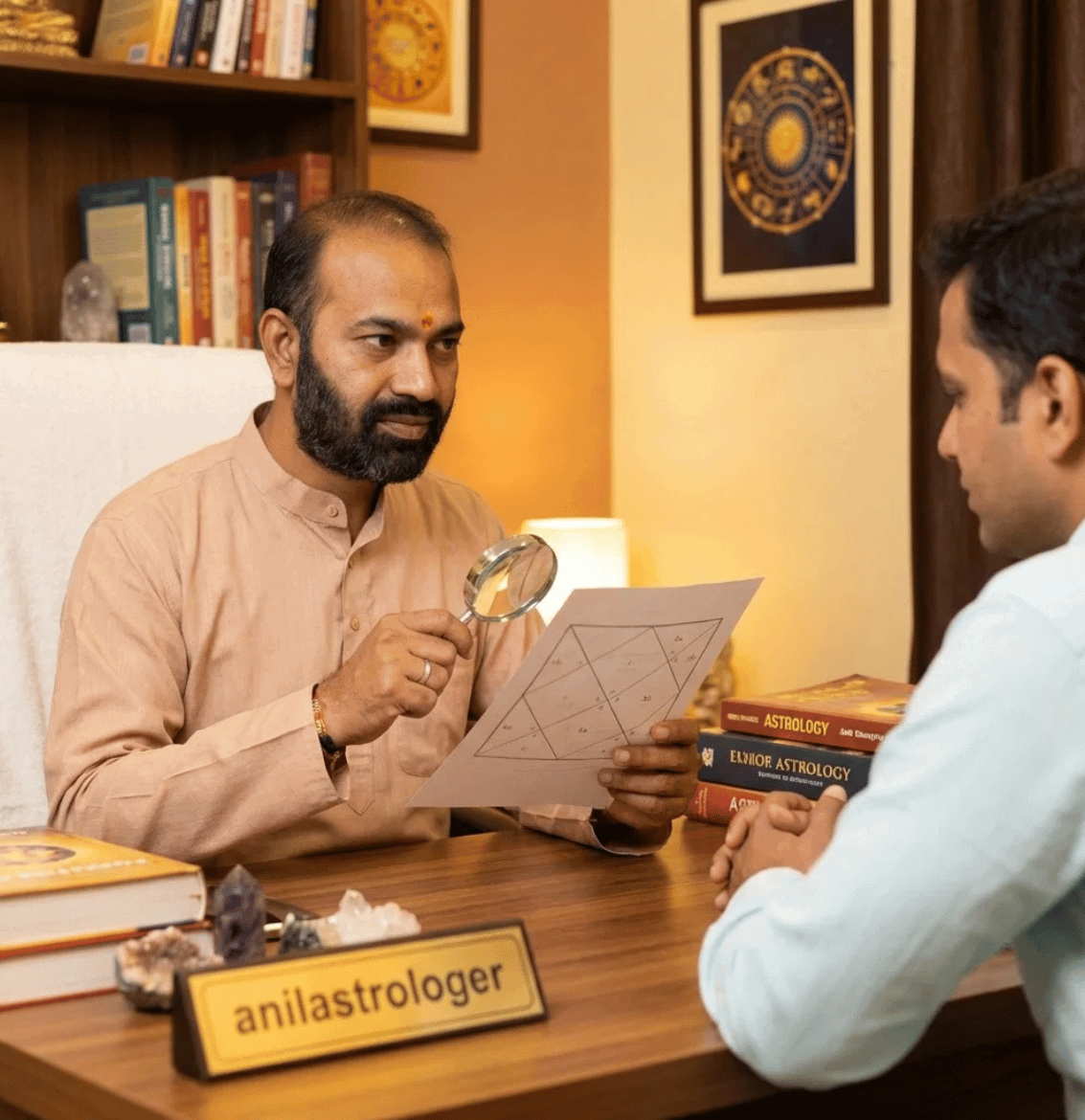
Pt. Anil Acharya Ji is a Vedic astrologer based in Surat, Gujarat, with 15+ years of experience and over 50,000 consultations. He specializes in love, marriage, and relationship astrology using Dasha-Antardasha timing, Navamsa D9 chart analysis, and Nakshatra-based remedies. Talk to him directly on WhatsApp.