
People come to me with this question all the time. They have heard the word somewhere — in a yoga class, on YouTube, from a family elder — and they want to understand what it actually means before they start chanting anything.
That caution is good. Beej mantras are not decorative. They are some of the most concentrated sounds in the Vedic tradition, and chanting the wrong one — or chanting the right one at the wrong time — can produce results you did not expect.
In 15 years of practice, I have seen both. Clients who chanted the correct Navagraha beej mantra during a difficult Dasha and felt the shift within weeks. And clients who picked a mantra off a random website with no understanding of their chart and got confused when nothing changed — or worse, when things got harder.
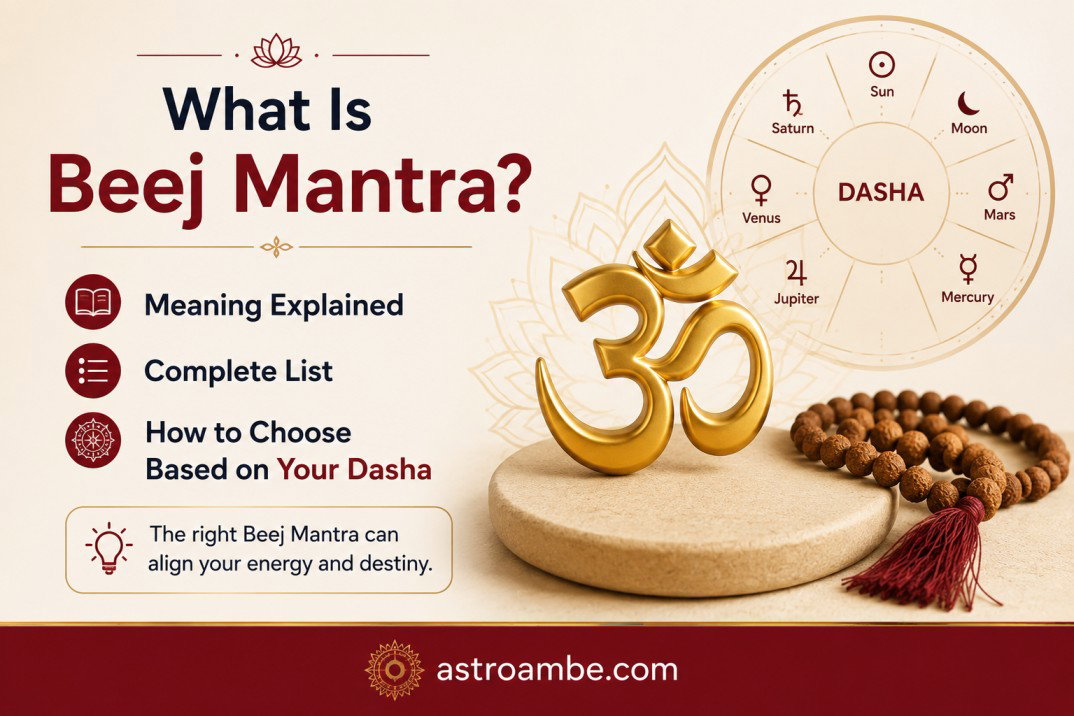
This article covers everything. What does the beej mantra actually mean? The three types. The complete list for all 9 planets with Devanagari script, romanization, meaning, chanting day, and jaap count. How to practice correctly. And the part most websites skip entirely: how to match the right mantra to your current Dasha period.
Read it properly. It will save you a lot of confusion later.
What Does Beej Mantra Mean?
The word ‘beej’ (बीज) means seed. The word ‘mantra’ (मंत्र) comes from manas (mind) and tra (instrument). So beej mantra literally means ‘a seed that is an instrument of the mind.’
A seed contains the entire tree within it. You cannot see the tree in the seed, but everything that will become the tree — the trunk, the branches, the fruit — is already there in compressed form. A beej mantra works the same way.
It is a single syllable, sometimes two or three syllables, that contains the compressed essence of a deity, a planet, or a cosmic force. When you chant it with proper pronunciation and sincere intent, that seed begins to sprout. The longer Vedic mantras you hear in temples and rituals are, in many cases, expansions of these seed syllables.
The oldest and most widely known beej mantra is OM (ॐ). In the tradition, OM is the primordial sound — the sound from which all other sounds and all creation arose. Every other beej mantra is, in some sense, a branch from this root.
Academically, bijamantra (Sanskrit: बीजमन्त्र) is classified as a monosyllabic mantra believed to contain the essence of a given deity. The Romanian scholar Mircea Eliade described it as a sound through which a practitioner ‘appropriates the ontological essence’ of the deity — meaning the sound and the divine energy are not separate. The mantra is not a request to the deity. It is the deity in sonic form.
Three Types of Beej Mantra
Most articles lump everything together. But there are three distinct categories, each with a different purpose and a different way of working.
1. Deity Beej Mantras (Devata Bija)
These invoke a specific god or goddess. Each deity in the Hindu tradition has a seed syllable that carries their energy in concentrated form. Chanting the deity’s beej mantra during their festivals, on their weekday, or as part of a longer sadhana strengthens your connection to that force.
Examples: SHREEM (श्रीं) for Goddess Lakshmi, AIM (ऐं) for Saraswati, KLEEM (क्लीं) for Kamdev, KREEM (क्रीं) for Kali, DUM (दुं) for Durga, HROUM (ह्रौं) for Shiva.
2. Navagraha Beej Mantras (Planetary Seed Mantras)
These are the beej mantras for the nine planets of Vedic astrology. This is the category most relevant to astrological remedies. Each planet has a seed syllable that, when chanted with the correct protocol, can strengthen a weak planet, pacify a malefic one, or help you work with a planet’s energy during its Dasha period.
I will cover all nine in detail in the next section. This is the most important category for anyone working with their Kundali.
3. Chakra Beej Mantras
These correspond to the seven chakras of the subtle body. They are used widely in yoga and meditation practice. Each chakra has an associated element, and its beej mantra works to balance that element within you.
LAM (लं) — Muladhara (Root Chakra, earth element). VAM (वं) — Swadhisthana (Sacral Chakra, water element). RAM (रं) — Manipura (Solar Plexus, fire element). YAM (यं) — Anahata (Heart Chakra, air element). HAM (हं) — Vishuddha (Throat Chakra, space element). OM (ॐ) — Ajna (Third Eye). The Sahasrara chakra at the crown has no seed syllable — it is accessed through inner silence, not sound.
Complete Navagraha Beej Mantra List — All 9 Planets
This is the table most people need, and almost no website gives it correctly in one place. Each planet has its full mantra, the seed syllable at its core, the correct day to begin chanting, and the number of repetitions traditionally prescribed for Siddhi (mantra completion) within a 40-day anushthaan.
Surya (Sun) | ॐ ह्रां ह्रीं ह्रौं सः सूर्याय नमः | Om Hraam Hreem Hraum Sah Suryaya Namah | Sunday (Ravivar) | 7,000 |
Chandra (Moon) | ॐ श्रां श्रीं श्रौं सः चंद्राय नमः | Om Shraam Shreem Shraum Sah Chandraya Namah | Monday (Somvar) | 11,000 |
Mangal (Mars) | ॐ क्रां क्रीं क्रौं सः भौमाय नमः | Om Kraam Kreem Kraum Sah Bhaumaya Namah | Tuesday (Mangalvar) | 10,000 |
Budha (Mercury) | ॐ ब्रां ब्रीं ब्रौं सः बुधाय नमः | Om Braam Breem Braum Sah Budhaya Namah | Wednesday (Budhvar) | 9,000 |
Guru (Jupiter) | ॐ ग्रां ग्रीं ग्रौं सः गुरवे नमः | Om Graam Greem Graum Sah Gurave Namah | Thursday (Guruvar) | 19,000 |
Shukra (Venus) | ॐ द्रां द्रीं द्रौं सः शुक्राय नमः | Om Draam Dreem Draum Sah Shukraya Namah | Friday (Shukravar) | 20,000 |
Shani (Saturn) | ॐ प्रां प्रीं प्रौं सः शनैश्चराय नमः | Om Praam Preem Praum Sah Shanaischaraya Namah | Saturday (Shanivar) | 23,000 |
Rahu | ॐ भ्रां भ्रीं भ्रौं सः राहवे नमः | Om Bhraam Bhreem Bhraum Sah Rahave Namah | Saturday (Shanivar) | 18,000 |
Ketu | ॐ स्त्रां स्त्रीं स्त्रौं सः केतवे नमः | Om Straam Streem Straum Sah Ketave Namah | Tuesday (Mangalvar) | 17,000 |
Note: Siddhi counts above follow traditional Vedic Shastra prescriptions. For daily practice without a formal anushthaan, 108 repetitions (one mala) on the planet’s day is the standard recommendation.
Want to know which planet needs attention in your Kundali? Chat with Pt. Anil Acharya Ji on WhatsApp → |
Which Beej Mantra Should You Chant? The Dasha Connection
This is the question most people cannot answer — and the reason is that most websites do not even ask it. They give you a list and say, ‘Chant for the planet causing problems.’ That is not wrong exactly, but it is incomplete.
In Vedic astrology, your life runs in planetary time periods called Dashas. The Vimshottari Dasha system divides your entire life into cycles ruled by different planets, each for a specific number of years. The planet whose Dasha you are currently running has an enormous influence on every area of your life — your health, relationships, career, finances, and spiritual development.
The Dasha ruler is, in most cases, the first planet to focus on when choosing a beej mantra. But there is nuance.
If your Dasha planet is benefic and well-placed in your chart
Chant that planet’s beej mantra to amplify its positive effects. You are in a good period — the mantra helps you receive its blessings more fully. Someone in a strong Jupiter Dasha, for instance, will find that regular Guru beej mantra practice deepens their wisdom, strengthens their teaching or advisory work, and brings opportunity.
If your Dasha planet is malefic or weak in your chart
Here is where people get confused. You still chant the Dasha planet’s mantra — but you also chant the mantra of the planet that pacifies it. For Shani Dasha, the Shani beej mantra is essential. But so is the Hanuman-focused Mangal mantra, because Mangal energy counterbalances Saturn’s weight. For Rahu Dasha, the Rahu mantra plus Jupiter’s Guru mantra works well together.
The Antardasha matters too.
Within each Mahadasha, there are sub-periods called Antardashas, each ruled by a different planet. When a difficult Antardasha runs inside an already challenging Mahadasha, the combined effect can be intense.
During these windows, adding the Antardasha planet’s beej mantra to your practice gives you something specific to work with rather than waiting it out.
A practical example from my practice
A client came to me during Shani Mahadasha with Budha Antardasha. She was having severe communication problems at work — misunderstandings, delays in paperwork, a stalled contract.
I recommended the Shani beej mantra on Saturdays and the Budha beej mantra on Wednesdays, both 108 times. She also started chanting the Buddha mantra each morning during the Mercury hora. Within six weeks, the contract came through, and the workplace situation settled considerably.
The mantras did not solve her problems by magic. What they did was help her maintain steadiness and attentiveness during a period when her chart was asking her to be careful with communication. That is how it usually works.
Deity Beej Mantras — With Meaning
Beyond the planetary mantras, these are the most widely used deity seed syllables. Each one has a specific application.
Goddess Lakshmi | SHREEM—श्रीं | Sha = Mahalakshmi, Ra = wealth, Ee = contentment. Chanted for prosperity, abundance, and material wellbeing. |
Goddess Saraswati | AIM—ऐं | Ai = Saraswati. For knowledge, education, clarity of speech, and the arts. Particularly useful for students. |
Kamdev / Krishna | KLEEM—क्लीं | Ka = Kamdev or Krishna. For attraction, love, desire, and emotional connection. One of the most potent love mantras. |
Goddess Kali | KREEM—क्रीं | Ka = Kali, Ra = Brahman, Ee = Mahamaya. For strength, protection, and removal of deep-seated obstacles. Requires guidance. |
Goddess Durga | DUM—दुं | Da = Durga, U = protection. For power, victory over enemies, and removal of fear. One of the safer protective mantras. |
Lord Shiva | HROUM—ह्रौं | Ha = Shiva, Au = Sadasiva. For moksha, protection from disease and sudden misfortune, and Shiva’s grace. |
Lord Ganesha | GLAUM—ग्लौं | Ga = Ganesha. For removing obstacles before beginning any new work, journey, or sadhana. Always chanted first. |
Lord Vishnu | AUM—ॐ | The universal seed mantra for Parabrahma, the formless absolute. Also the root of all beej mantras. |
Beej Mantra for Love, Marriage, and Relationship Problems
This is the area where I get the most questions, so I want to address it directly.
If you are facing love problems, delays in marriage, separation from a partner, or difficulty in attracting a relationship, the relevant planets in Vedic astrology are Venus (Shukra), Jupiter (Guru), and the Moon (Chandra). The relevant houses are the 7th house (partnership), the 5th house (romance and love), and the 2nd house (family).
The three beej mantras most relevant to relationship situations:
Shukra Beej Mantra — for Venus
ॐ द्रां द्रीं द्रौं सः शुक्राय नमः(Om Draam Dreem Draum Sah Shukraya Namah)
Venus is the primary planet of love, attraction, marriage, and harmony in Vedic astrology. When Venus is weak, afflicted by Rahu, Ketu, or Saturn, or placed badly in the 6th, 8th, or 12th house, relationship difficulties follow. Chanting the Shukra beej mantra on Fridays (Venus’ day), 108 times, strengthens Venus energy. During a Shukra Dasha or when Venus is transiting your 7th house, this practice is especially effective.
KLEEM — for Attraction and Love
क्लीं(Kleem)
Kleem is one of the most potent seed syllables for attraction and emotional connection. It is associated with Kamdev, the deity of desire, as well as with Krishna. For love and relationship concerns, many practitioners combine Kleem with the full Shukra mantra or use it as a prefix to other relationship mantras. I always recommend getting guidance before working with Kleem independently, as its energy is quite concentrated.
SHREEM — for Marital Happiness and Prosperity
श्रीं(Shreem)
Shreem invokes Mahalakshmi’s energy of abundance and auspiciousness. In the context of marriage, it is associated with a happy, stable household. Chanting Shreem 108 times daily, particularly on Fridays and full moon days, is a traditional practice for those wishing to attract a good partner or improve the quality of an existing marriage.
Important: For serious relationship problems — separation, divorce, persistent delays in marriage — a mantra alone is rarely enough. A proper remedy requires first understanding the actual state of your chart: the 7th house, Venus, Jupiter, and any doshas present. The mantra is then one part of a complete approach that may include gemstones, specific rituals, and timing guidance. Chat with me on WhatsApp to discuss your situation: +91 95862 84891 |
How to Chant Beej Mantra — The Correct Method
The pronunciation and the ritual frame both matter. A mantra chanted carelessly is like a seed thrown on concrete. It has potential, but it will not germinate.
Before You Begin
Take a bath before your practice. This is not only about physical cleanliness — it is about signaling to your mind and your body that what follows is different from ordinary activity. If an early-morning bath is not possible, wash your hands, face, and feet, and sprinkle a few drops of water on your head while setting your intention.
Wear clean clothes. Preferably cotton, preferably in a color associated with the planet you are working with. For Shani, dark blue or black. For Shukra, white or cream. For Surya, orange or red. For Chandra, white or silver.
Sit in a clean, quiet space. The same place every day if possible — over time, this space begins to hold the energy of your practice.
Direction to Face by Planet
Surya (Sun) | East |
Chandra (Moon) | East |
Mangal (Mars) | East |
Budha (Mercury) | East |
Guru (Jupiter) | East |
Shukra (Venus) | East |
Shani (Saturn) | West |
Rahu | South |
Ketu | South |
The Mala
Use a mala (prayer beads) to count your repetitions. 108 beads, one repetition per bead. For Navagraha practice, a rudraksha mala is the standard choice and works for all nine planets. For deity mantras, the traditional associations apply: a crystal mala for Saraswati and Shiva, a red coral mala for Durga and Mangal, and a tulsi mala for Vishnu.
Do not use the index finger to turn beads. Use the thumb and the middle finger. The index finger is considered inauspicious in mantra japa.
Timing
The best time is Brahma Muhurta — roughly 4 AM to 6 AM, depending on sunrise at your location. The mind is naturally quieter at this time, and the atmosphere is less cluttered with the mental noise of daily activity.
If that is not practical, the second-best option is the planetary hora. Each hour of the day is ruled by a different planet, cycling through in a specific order. Chanting a planet’s beej mantra during its hora — on its own day — is powerful. Planetary hora calculators are widely available online.
Sunrise is also always acceptable for any planetary mantra.
Pronunciation
This is where most people struggle. Sanskrit pronunciation is precise, and beej mantras in particular carry their energy in the exact quality of the sound. The nasalized sounds — the anusvara, the specific length of vowels — all matter.
If you have never chanted Sanskrit before, listen to an authenticated recording several times before beginning your own practice. Many experienced practitioners chant slightly incorrectly for years because they learned from a source that was itself imprecise. If possible, learn the pronunciation from a qualified pandit or guru in person.
The key sounds to get right in Navagraha mantras: the thrē-vowel sequence (hraam, hreem, hraum for Surya, for example) and the long vowels versus short. These are not interchangeable.
Jaap Count and Consistency
For daily maintenance practice: 108 repetitions (one mala round) on the planet’s day. This is the baseline for most people.
For a formal 40-day anushthaan aimed at Siddhi, commit to a daily count that will reach the target within 40 days without decreasing. If you commit to 200 per day, you can increase to 300 — but you cannot drop back to 100. Missing a day restarts the count from zero in the traditional view, though some teachers allow one missed day within the 40.
Consistency over months matters more than any single intensive burst. I tell every client: six months of 108 daily repetitions will move your chart energy more reliably than a single marathon session.
Which Beej Mantras Require Guru Initiation?
Most people do not know this, and it is one of the more important things I want to say in this article.
Not all beej mantras are safe for self-directed practice. Some work beautifully without any formal initiation — the Navagraha mantras, OM, Shreem, Glaum for Ganesha, and the chakra beej mantras all fall in this category. Consistent, sincere chanting with these carries no real risk.
Others carry a different kind of charge. They invoke fierce deities, Tantric forces, or energies that can intensify whatever is already present in a person’s life — including things they would prefer not to intensify.
Mantras that traditionally require initiation or, at a minimum, very careful guidance:
KREEM (क्रीं) — Kali. Kali’s energy is transformative, not gentle. She removes what no longer serves, but the removal process can be disorienting. This mantra is powerful precisely because it does not soften. It should be received from a qualified teacher.
HOOM (हूं) — Bhairav. This is the seed syllable for Kaal Bhairav, one of the most fierce manifestations of Shiva. Associated with rapid results and also with consequences for misuse. Not for independent practice.
BAGALAMUKHI mantra and most Dasha Mahavidya seed syllables. These are specific to Shakta Tantra and require formal diksha (initiation).
KLEEM in certain contexts. In its benign form — attraction and love — Kleem is generally safe. But in Tantric applications, it is part of more complex practices that require proper guidance.
If someone offers to teach you one of these mantras in a five-minute video or a single-page article, be careful. This is not gatekeeping. It is the same principle as not handing someone a scalpel and a medical textbook and calling it surgery.
Case Study — How Beej Mantra Practice Helped During Sade Sati
A client I will call Rajesh came to me about two years ago. He was in the middle of Sade Sati — the seven-and-a-half-year period when Saturn transits through the sign before your Moon sign, your Moon sign itself, and the sign after it. His Moon was in Tula (Libra), and Shani had entered Kanya the year before.
He was facing a combination of things that often appear during a hard Sade Sati: pressure at work, friction at home, and a sense of being stuck he could not quite explain. He was not in crisis, but everything felt heavier than it should.
I looked at his chart. Shani was actually his Yogakaraka — a functionally beneficial planet for his ascendant. The Sade Sati was not purely malefic. But it was demanding inner work that Rajesh was not doing, which was why it felt stuck rather than constructively difficult.
I gave him two things. The Shani beej mantra — Om Praam Preem Praum Sah Shanaischaraya Namah — is recited 108 times every Saturday morning, facing west, after a bath, using a rudraksha mala. And an instruction: during the chanting, instead of asking Saturn to go away, to simply sit with what the transit was teaching him.
Three months later, he came back. The external situation had not transformed completely — that is not how Sade Sati works. But he had stopped fighting it, and in stopping the fight, several things had become clearer.
A decision at work that had been blocked for months, he finally made. The friction at home, he saw, came partly from his own tension and partly from his wife’s anxiety about their finances. He was able to address both more calmly.
A year into the practice, he is through the peak of the transit. He describes the last two years as ‘the most difficult and also the most clarifying of my life.’ That is Saturn working correctly. The mantra did not remove the difficulty. It helped him meet it.
Ready for a personalised chart reading and mantra remedy? Chat with Pt. Anil Acharya Ji on WhatsApp → |
Beej Mantra — Hindi Mein Saar (संक्षिप्त परिचय)
बीज मंत्र का अर्थ — Beej mantra ka arth hai 'beej' jaise ek chhota sa shabd jo puri shakti ko apne andar samete hue hai. Jaise ek beej mein pura ped hota hai, waise hi beej mantra mein us devata ya grah ki poori urja compressed form mein hoti hai.
कौन सा बीज मंत्र जपें? — Sabse pehle yeh jaanein ki aapke Kundali mein kaun sa grah kamzor hai ya kaun si Dasha chal rahi hai. Usi grah ka beej mantra sabse pehle jaapna chahiye. Agar Shani ki Mahadasha hai, to ॐ प्रां प्रीं प्रौं सः शनैश्चराय नमः ka jaap Shanivar ko 108 baar karein.
जाप का सही समय — Brahma Muhurta (suryoday se pehle 4-6 baje) sabse uchit samay hai. Nahan ke baad, saaf kapde pehen kar, shant jagah par baith kar, rudraksha mala se jaap karein.
कितनी बार जपें? — Aam taur par roz 108 baar (ek mala) kaafi hai. Agar 40-din ka anushthaan karna ho, to planet-wise target count ko us period mein poora karein — jaise Shani ke liye 23,000, Shukra ke liye 20,000.
प्रेम और विवाह के लिए — Shukra beej mantra (ॐ द्रां द्रीं द्रौं सः शुक्राय नमः) Shukravar ko 108 baar, aur Shreem (श्रीं) ka jaap — yeh dono shaadi mein aane wali rukawaton ke liye sabse zyada upyogi hain. Kundali ke anusar sahi mantra ki jankari ke liye mujhse WhatsApp par baat karein.
Common Mistakes People Make With Beej Mantras
In 15 years of advising people on mantra practice, I have seen the same errors repeatedly. They are worth naming clearly.
Chanting without understanding the meaning. You do not need to understand the mantra’s full philosophical depth. But knowing broadly what you are invoking and why matters. A mantra chanted with understanding is different from one chanted as mere repetition of syllables, with no internal connection.
Picking a mantra based on social media popularity. Kleem and Shreem have become popular because they sound appealing and are presented as quick fixes for love and money. But the correct mantra for your situation depends on your specific chart, not a general prefereChanting Shreem obsessively when your actual problem is a malefic Venus that needs to be pacified with the Shukra mantra will not yield the result you want.want.
Chanting inconsistently. One week of daily practice, then nothing for three weeks, then starting again. This does not work. The vibration needs to build over time. Missing occasional days is human — missing weeks is starting over.
Chanting too many mantras at once. I have had clients tell me they are chanting six different planetary mantras every day, 108 times each, because they read that all six planets are weak in their chart. This is neither practical nor necessarily effective. One or two mantras, chanted consistently and correctly, will do more than six chanted frantically.
Expecting results in the wrong form. Beej mantra practice tends to work subtly at first. You feel calmer. Decisions become clearer. The right person shows up. The path that was blocked starts to open. People who are waiting for a dramatic miracle often miss the quieter changes that are actually happening.
Frequently Asked Questions
What is the most powerful beej mantra?
OM is the root of all beej mantras and is considered the most fundamental. Among deity mantras, this depends on your specific need and relationship to the tradition. Among planetary mantras, the one most relevant to your current Dasha period is the most powerful for you personally at this point in time. Power is not universal — it is contextual.
Can women chant beej mantras during menstruation?
Opinions differ among traditional practitioners on this point. The more conservative view holds that menstruation is a period of inward energy and that elaborate external rituals are best paused. Many contemporary teachers, particularly those trained in tantric lineages, say there is no restriction on mantra chanting, only on elaborate puja with fire and physical ritual objects. I recommend following the guidance of your own tradition or teacher on this.
How long before the Beeja mantra practice shows results?
40 days is the traditional minimum for a formal anushthaan to complete. For general daily practice, most people notice some shift in their mental state and focus within four to six weeks. External results — changes in relationships, career, financial situation — tend to take longer and often come in forms you did not anticipate. Patience and consistency are the only shortcuts.
Is the beej mantra the same as a seed mantra?
Yes. Seed mantra is the direct English translation of beej mantra. Bija mantra (Sanskrit romanized) and beej mantra (Hindi pronunciation) refer to the same thing. Some Western yoga traditions use ‘bija’ more commonly.
Can I chant the Beej mantra without initiation?
For most beej mantras — including all nine Navagraha mantras, OM, Shreem, Aim, Glaum, and the chakra mantras — yes. These are in the category of mantras available to sincere practitioners without formal diksha.
For certain Tantric seed syllables (Kreem, Hoom, and the Mahavidya mantras), initiation is the traditional requirement, and I would follow that guidance.
What is the difference between a beej mantra and a Gayatri mantra?
A beej mantra is a single syllable or short compound syllable — the seed. A Gayatri mantra is a full 24-syllable Vedic hymn in the Gayatri meter, dedicated to a specific deity. Each deity can have both their beej mantra (the seed) and their Gayatri mantra (the full hymn). The beej mantra is more concentrated; the Gayatri is more expansive. In practice, they are often combined or used for different purposes within the same sadhana.
How do I know if my mantra practice is working?
The first sign is usually internal: a quieter mind during the chanting period, less reactivity during the day, a sense of steadiness that was not there before. External signs come later and are rarely dramatic — a situation that was stuck begins to move, a relationship becomes less tense, an opportunity presents itself. If after three months of sincere daily practice you notice no change at all in any area of your life, it is worth consulting with an astrologer to check whether the mantra is correctly matched to your chart.
Related Services and Pages
If you are working on a specific problem and would like to go deeper:
• Lost Love Back —
• Love Calculator —
Get a personal mantra remedy based on your chart. WhatsApp Pt. Anil Acharya Ji: +91 95862 84891 → |
Pt. Anil Acharya Ji|Jyotishacharya|15+ Years Experience|50,000+ Consultations|4.9 ★ Google Rating